
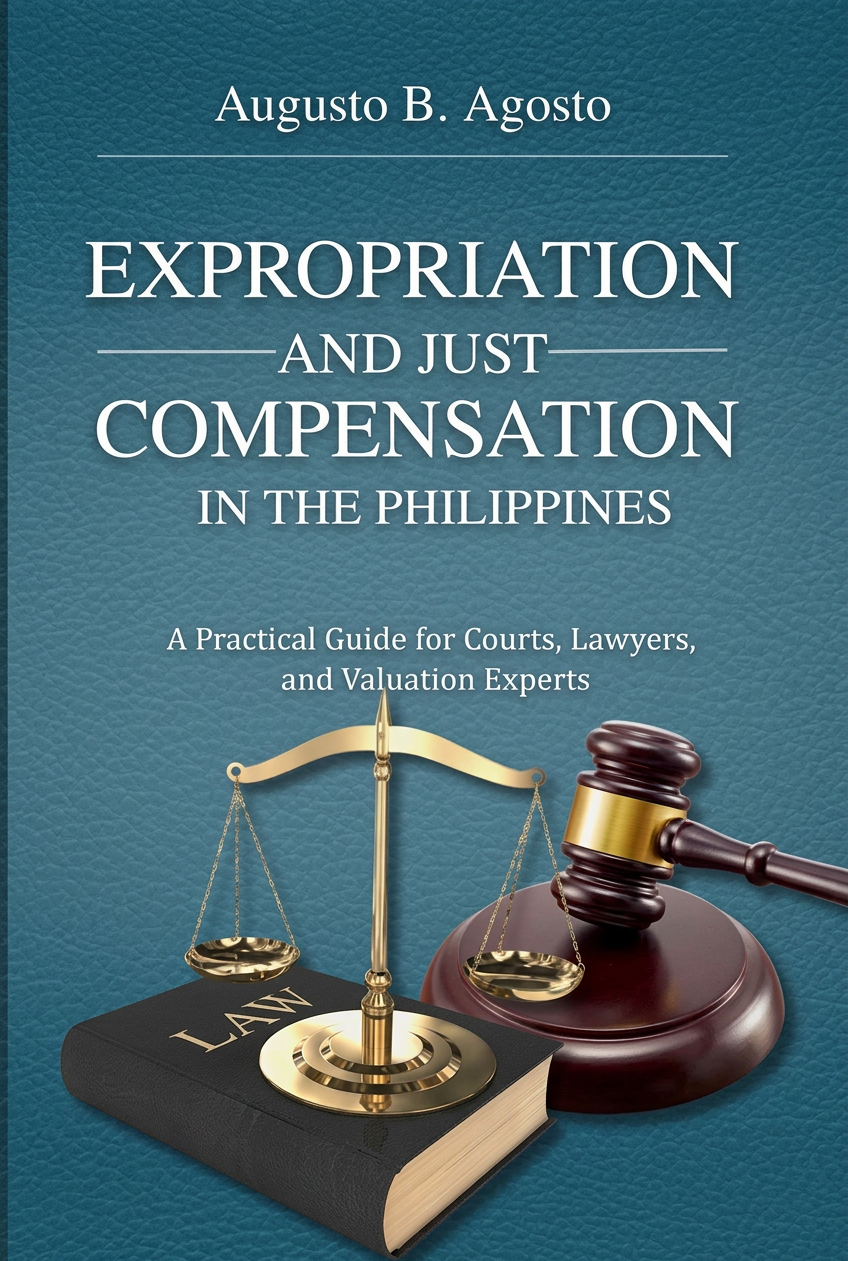
The book “Expropriation and Just Compensation” is the product of a long and deliberate journey—one shaped by more than a decade of experience in the courtroom, sustained practice in the field of real estate appraisal, and rigorous academic inquiry. It is both a culmination of years of study and practice, and a response to the persistent need for a clearer, more integrated understanding of just compensation in Philippine law and valuation.
The author’s engagement with the subject began during his legal studies, when he first encountered the constitutional provision on eminent domain under Article III, Section 9 of the 1987 Constitution. This provision, which guarantees that private property shall not be taken for public use without just compensation, sparked my initial curiosity. It raised fundamental questions: What does it truly mean to be “justly compensated”? How is this principle applied in practice? And how can the law ensure that property owners are made whole when their property is taken?
This early interest marked the author’s first attempt to understand the delicate balance between the State’s power of eminent domain and the individual’s constitutional right to fair compensation.
This foundation was further strengthened during his studies in Land Valuation and Management at the University of the Philippines, particularly in the subject of Statutory Valuation. It was during this period that he wrote the article “Notes on Eminent Domain and Just Compensation,” where he began to systematically examine how legal principles interact with valuation practice. He also explored the application of various real estate laws and their implications in determining property value. This phase deepened his appreciation of the critical role that legal frameworks play in shaping valuation outcomes. It highlighted the need to bridge the gap between legal doctrine and appraisal methodology.
Beyond the classroom, the author had the opportunity to deliver lectures on statutory valuation and complex valuation in various parts of the country. His lectures have been written in this blog and posted on YouTube. He was also asked to serve as a Court Commissioner and Expert Witness to represent clients. These engagements exposed him to the real-world challenges faced by appraisers, lawyers, government agencies, and courts in implementing the concept of just compensation. In practice, he observed recurring issues—delays in resolution, inconsistencies in valuation, and difficulties in reconciling legal standards with market realities. It became increasingly clear that while the principles of just compensation are well-established in law, their application remains complex and, at times, fragmented.
From these experiences emerged a long-standing realization: there was a need for a comprehensive yet practical guide that could assist practitioners and decision-makers in navigating the intersection of law and valuation. The idea of writing a book that would address this need was conceived during these years and has now come to fruition.
More recently, his masteral studies in law at the University of Santo Tomas culminated in my thesis, “Restoring the Whole: Just Compensation in Agrarian Reform and Right-of-Way Expropriation.” This work significantly enhanced his theoretical grounding and allowed me to examine the doctrinal, institutional, and practical dimensions of compensation across different legal regimes. It also reinforced a central insight that underpins this book—that just compensation is not merely a legal requirement, but a process that must reconcile economic value, legal standards, and equitable outcomes.
Altogether, these experiences—academic, professional, and practical—form the foundation of this work. This book is not only a consolidation of prior studies and reflections, but also a continuing effort to contribute to a more coherent, principled, and practice-oriented understanding of expropriation and just compensation in the Philippines.
The author hope that this work aspires to serve as a guide for those engaged in the field—whether as appraisers, lawyers, judges, or policymakers—by offering both doctrinal clarity and practical insight into one of the most important and complex areas of property law. For in the end, just compensation is not simply a number—it is a principle. And unless that principle is understood and faithfully applied, the promise of the Constitution remains incomplete.
 Real Appraisal