Beyond Land and Infrastructure: Rethinking the Valuation of Water-Dependent Enterprises

By Augusto B. Agosto, JD, EnP, Economist, Consultant

Introduction

When most people think of property valuation, they picture land, buildings, machinery, and infrastructure—tangible assets that can be easily inspected, measured, and compared in the marketplace. For water-dependent enterprises, however, a more fundamental question often arises: What is the value of the resource that makes the entire enterprise possible?

A water treatment plant without water has little utility; pipelines without water cannot generate revenue; and reservoirs without water are merely empty storage facilities. Yet, traditional valuation approaches often focus heavily on physical assets while giving limited attention to the underlying resource and the legal rights that govern access to it.

Recent professional engagements involving bulk water supply systems, utility infrastructure, and water-related enterprises prompted me to revisit a question that sits precisely at the intersection of law, economics, environmental planning, and valuation: Can the value of a water enterprise be fully explained by land and physical improvements alone? The answer is considerably more complex than conventional appraisal practice suggests.

Who Owns the Water?

The starting point of any discussion on water rights in the Philippines is the Regalian Doctrine. Under Article XII, Section 2 of the Constitution, all natural resources—including waters—belong to the State. The Water Code of the Philippines (Presidential Decree No. 1067) further reinforces this by declaring that private entities may acquire only the right to appropriate and utilize water, subject to strict state regulation.

This distinction is critical for valuation professionals: private entities generally do not own the water itself. Instead, they acquire the legal authority to access, extract, treat, distribute, and utilize water for beneficial purposes. While a water permit is merely an administrative authorization from a legal perspective, from an economic perspective, that authorization represents a monumental source of value.

Water Rights as Economic Assets

Economics teaches us that value arises from scarcity. Although the Philippines is traditionally viewed as an island nation rich in water resources, many regions face acute water stress driven by population growth, rapid urbanization, watershed degradation, groundwater depletion, and climate-induced seasonal variability. As access to reliable water becomes premium, the economic significance of water rights increases proportionally.

Water rights act as economic catalysts by providing:

  • Access to a Scarce Resource: Guaranteed entry into a restricted natural market.
  • Security of Supply & Legal Certainty: Risk mitigation against operational disruptions and litigation.
  • Priority of Use & Investment Opportunities: The baseline confidence required to deploy heavy capital for infrastructure development.

In effect, water rights serve as the operational bridge that converts unpriced natural resources into productive, revenue-generating economic assets.

Lessons from Practice: Beyond Tangible Assets

Several recent valuation assignments involving watershed-based bulk water supply systems and utility infrastructure projects forced a departure from standard real estate appraisal. These engagements required an evaluation that looked beyond physical infrastructure to assess raw water sources, regulatory authorizations, off-take contractual arrangements, and long-term hydrological sustainability.

One particular assignment involving a watershed-based bulk water supply system raised several non-traditional questions:

  • What precise portion of enterprise value is truly attributable to land versus physical improvements?
  • How should the raw, productive capacity of the surrounding watershed be quantified?
  • What is the isolated economic value of the right to abstract and distribute water?
  • How does the long-term reliability of the water source impact overall enterprise risk and value?
  • To what extent do administrative permits and contractual off-take agreements contribute to the ongoing economic viability of the operation?

Answering these questions required moving past conventional property appraisal and venturing into resource economics, institutional rights, environmental planning, and natural capital accounting. The valuation ultimately demonstrated that the economic performance of the enterprise could not be explained solely by its tangible assets. A massive portion of its utility and income-generating capacity was inherently tied to the underlying water resource and the institutional frameworks safeguarding access to it.

Two Paths to Water Production

Observation of water enterprises in Cebu reveals an interesting operational dichotomy. Different enterprises produce marketable water through completely different asset profiles:

Production TypologyResource ReliancePrimary Value Driver
Natural Capital-DependentWatersheds, springs, and deep groundwater systems.High reliance on natural replenishment and ecological health.
Technology-DependentDesalination plants and advanced treatment systems converting seawater or brackish water.High reliance on produced capital, energy inputs, and technological investments.

While both typologies generate revenue by delivering the same end product, their underlying asset structures differ fundamentally. One depends heavily on natural ecosystems; the other depends on engineered physical infrastructure. Yet, both share the same economic reality: without access to the baseline water resource (whether raw fresh water or raw seawater), neither infrastructure nor technology can generate revenue.

Natural Capital and Water Resources

The emerging field of natural capital accounting provides a precise framework for modernizing valuation practice. Natural capital refers to natural assets capable of generating flow-of-resource economic benefits. In this context, it encompasses:

  • Watersheds, aquifers, and natural springs.
  • Rivers, recharge areas, and critical forest ecosystems that regulate hydrological cycles.

Without healthy watersheds and functioning hydrological systems, physical water supply infrastructure loses its utility. Consequently, the comprehensive valuation of water enterprises demands that we look upstream at the sustainability and ecological health of the resource provider.

These initiatives have significantly advanced the measurement of water resources, ecosystem services, and natural capital. However, an important gap remains. Much of the existing literature focuses on water availability, water use, allocation, pricing, and conservation. Far less attention has been devoted to understanding how water resources create economic value and how institutional arrangements governing access to those resources influence investment, enterprise development, and wealth creation.

In particular, limited research has examined the role of water rights as institutional mechanisms that transform water resources into productive economic assets. The interaction between natural capital, legal entitlements, infrastructure investment, and economic production remains largely unexplored in the Philippine context. Understanding this relationship is increasingly important as water scarcity, climate risks, and competing resource demands place greater emphasis on the economic significance of water resources.

These questions form the foundation of the author’s ongoing research, which seeks to examine how scarcity, institutions, and water rights interact to create economic value within water-dependent enterprises and, more broadly, within the Philippine economy.

Conclusion

The discussion on water rights ultimately leads to a broader question than valuation itself. While appraisal seeks to measure value, economics seeks to understand how value is created. In the case of water-dependent enterprises, the answer extends beyond land, buildings, treatment facilities, and infrastructure.

The experience of examining bulk water systems suggests that economic value originates from the interaction of natural capital, institutions, and investment. Watersheds, aquifers, springs, and other water resources provide the physical foundation. The State, through the Regalian Doctrine and the Water Code, establishes the institutional framework governing access and allocation. Water rights and permits create certainty, enabling investment in infrastructure, treatment systems, and distribution networks that transform natural resources into economic output.

Viewed from this perspective, water rights are more than regulatory instruments. They serve as institutional mechanisms that connect natural capital to economic production. Understanding their role requires moving beyond traditional discussions of water use and toward a deeper examination of how water resources contribute to enterprise value, regional development, and national wealth.

Recent initiatives such as PENCAS, the PSA Water Accounts, and national water resource assessments signal a growing recognition of the economic importance of natural assets. Yet important questions remain. How do watersheds create economic value? How do institutions influence the allocation of scarce water resources? How do water rights support investment, productivity, and long-term development? These questions remain largely unexplored within Philippine literature and present opportunities for future research.

The inquiry that began as a valuation problem has therefore evolved into a broader economic question: how does a water resource become economic value? Exploring that question may not only improve valuation practice but also contribute to a deeper understanding of water governance, natural capital, and sustainable development in the Philippines. As water scarcity and climate-related challenges become increasingly significant, the ability to understand and account for the value created by water resources may prove essential to both economic policy and resource management in the decades ahead.

When an Appraisal Crossed the Line: A Story from Mejia v. People

There was nothing extraordinary about the assignment.

A bank needed a valuation. A borrower offered a house and lot as collateral. An appraiser—trained, licensed, experienced—went to the property, took measurements, observed the structure, and later submitted a report.

On paper, the numbers looked strong.

The property was valued at around PhP 22.8 million, and based on that figure, the bank approved a loan of roughly PhP18 million.

Everything followed the usual rhythm of banking practice:
valuation → approval → release.

No alarms. No hesitation.

At least, not yet.

Time, however, has a way of testing assumptions.

The borrower defaulted.
The bank foreclosed.

And when the property was subjected to a fresh valuation—this time under the pressure of recovery rather than approval—the numbers changed dramatically.

PhP10 million.
PhP9 million.
PhP8 million.

The earlier figure—PhP22 million—no longer looked like a judgment call.

It looked like a distortion.

When the case eventually reached the Supreme Court in Mejia v. People, the issue was not simply whether the appraisal was inaccurate.

Courts are familiar with disagreements in valuation. Markets move. Methods differ.

But this case was not about methodology.

It was about facts.

The floor area had been reported at more than 800 square meters, when in truth it was only around 250 square meters.
The structure was described as a two-storey building, when it was in reality a split-level, one-storey house.

These were not technical adjustments.

They were inputs that create value itself.

And more importantly, they were inputs that the appraiser knew would matter—because the report was never meant to remain theoretical.

It was meant to move the bank.

That is where the law enters the story.

The charge was not negligence.
Not incompetence.

But violation of the General Banking Law—specifically, overvaluing property for the purpose of influencing bank action.

And here lies the most important clarification the Court made:

Not every overvaluation is a crime.
It becomes a crime when it is done with intent to influence the bank’s decision.

This is where the worlds of appraisers and lawyers converge.

For appraisers, valuation has always been framed as professional judgment.

For lawyers, liability begins when intent and effect meet.

In this case, the Court saw both.

The appraiser argued that the property was “1.5 storeys,” and that the software required him to input “2.” That may sound technical, even reasonable at first glance.

But the Court focused on something deeper:

If he knew the description was not exact,
why did he not disclose it?

Why was there no remark?
No qualification?
No warning that the figure might not reflect reality?

That silence became crucial.

Because in law, especially when others rely on your statement:

What you do not say can be just as powerful as what you do.

The Court then drew the final line.

The valuation was not just wrong.
It was relied upon.

It influenced the bank’s decision.
It led to the approval of the loan.
It exposed the bank to loss.

And because of that chain—from report to reliance to consequence—the appraisal was no longer just a document.

It became an act with legal effects.

The conviction was affirmed.

And this is where the story turns into a lesson—especially for professionals like us.

For the appraiser, the case transforms the nature of the work:

Valuation is no longer insulated as “mere opinion.”
Once relied upon, it becomes a representation of fact.

For the lawyer, the case provides a powerful framework:

A technical report can become criminal evidence when:

  • There is misrepresentation of material facts
  • There is intent to influence
  • There is actual reliance

For both, the boundary between disciplines disappears.

The appraiser must now think like a lawyer:
What are the consequences of this statement?

The lawyer must think like an appraiser:
What inputs created this number?

But perhaps the most important lesson is this:

The market eventually corrects value.
But the law examines how that value was presented.

And when the presentation itself is distorted—
especially in a way that moves money, decisions, and institutions—

it ceases to be a professional error.

It becomes a legal wrong.

In the end, Mejia v. People is not just about one appraiser.

It is about a system built on trust.

Banks trust valuations.
Courts trust experts.
Markets trust signals.

And the moment those signals are knowingly distorted,

the law steps in—not to correct the value—

but to correct the conduct.

Mejia v. People establishes a clear doctrinal boundary:

Valuation is protected as opinion only up to the point that it remains analytical.
Once it influences decisions through misrepresented facts, it becomes actionable under the law.

For appraisers and lawyers alike, the message is unequivocal:

  • Value must be accurate
  • Assumptions must be transparent
  • Reports must be defensible

Because in modern practice, valuation is no longer just a technical exercise.

It is a legal responsibility.

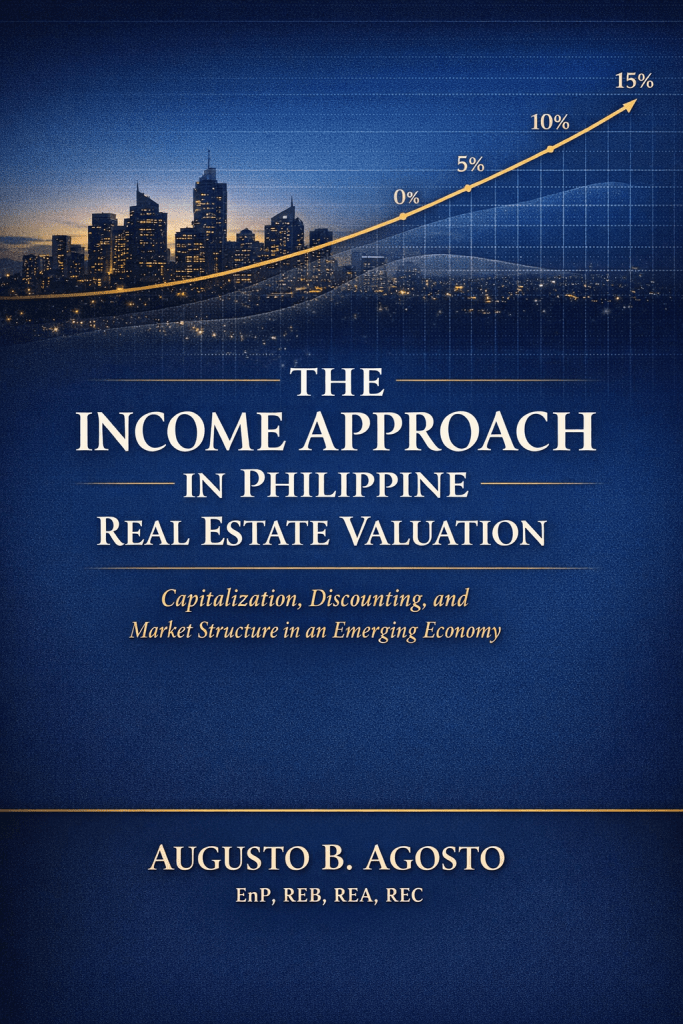
Why the Income Approach Matters Now — And Why This Book Was Written

In every skyline, there is a story about capital.

Behind every office tower in Makati, every BPO building in Cebu IT Park, every industrial warehouse in Mandaue, and every resort hotel along our coastlines lies the same underlying question:

What is this property worth — and why?

For many, valuation is seen as a technical exercise. A computation. A compliance requirement for banks, regulators, or courts.

But income-producing real estate is not valued by arithmetic alone.

It is valued by expectation.

It is valued by risk assessment.

It is valued by how capital markets price future cash flow.

That is the intellectual foundation of the Income Approach — and that is why I wrote this book.

The Gap in Philippine Valuation Practice

In the Philippines, the Sales Comparison and Cost Approaches are widely applied. They remain essential. However, when we deal with commercial buildings, office towers, malls, industrial estates, mixed-use projects, and hotels, the economic reality is clear:

These assets are bought and sold for their income.

Yet income-based valuation is still unevenly practiced. Outside major appraisal firms and institutional transactions, Direct Capitalization and DCF modeling are often simplified, inconsistently applied, or misunderstood.

At the same time:

  • The Supreme Court has recognized income-based methodologies in appropriate cases.
  • REIT participation is reshaping yield expectations.
  • Institutional capital is influencing cap rate compression.
  • Infrastructure projects are shifting growth assumptions.
  • Regional markets like Cebu are evolving rapidly.

The Philippine real estate market is maturing.

Our valuation discipline must mature with it.

What This Book Offers

This book is not a collection of formulas.

It is a structured explanation of the economic and financial logic behind the Income Approach — adapted to the Philippine market environment.

Inside, readers will find:

  • A rigorous construction of Potential Gross Income
  • Realistic modeling of vacancy and collection loss
  • Disciplined treatment of operating expenses and replacement reserves
  • The doctrine of Net Operating Income integrity
  • A clear explanation of Direct Capitalization theory
  • A practical, step-by-step guide to Discounted Cash Flow (DCF) modeling
  • A deep exploration of the relationship between r (discount rate), R (cap rate), and g (growth)
  • Philippine-specific methods of cap rate derivation and market extraction
  • Case studies from Makati, Cebu, provincial CBDs, industrial corridors, and resort properties
  • A structured approach to reconciliation and professional judgment

More importantly, the book demonstrates that Direct Cap and DCF are not competing tools — they are mathematically connected expressions of capital market logic.

Understanding that relationship transforms valuation from spreadsheet exercise into economic analysis.

Who Should Read This Book?

This book is written for:

  • Professional appraisers and valuers who want deeper analytical discipline.
  • Lawyers and judges dealing with expropriation, shareholder disputes, or partnership cases involving income-producing property.
  • Real estate investors and developers who want to understand how markets price risk and growth.
  • Students of real estate, finance, and urban economics who want to move beyond memorized formulas.
  • Policy thinkers and planners who want to understand how capital flows shape urban value.

If you are involved in property where income matters, this framework matters.

Why This Conversation Is Important

Small changes in assumptions can move value by tens or hundreds of millions of pesos.

  • A 0.5% shift in cap rate.
  • A 1% change in growth.
  • A slight adjustment in vacancy.
  • An underestimated expense ratio.

The Income Approach magnifies assumptions.

That is why integrity, transparency, and disciplined modeling are essential.

A capitalization rate is not “chosen.”
It is defended.

A discount rate is not “assumed.”
It is justified.

Growth is not “optimistic.”
It is sustainable.

This book invites practitioners to approach income valuation with that level of seriousness.

An Invitation to Engage

Real estate is not static. It reflects economic structure, institutional confidence, liquidity, infrastructure, and long-term expectations.

When we value property through income, we are not simply dividing numbers.

We are interpreting capital market psychology.

If you are ready to deepen your understanding of how income becomes value — and how risk and growth shape pricing in the Philippine context — I invite you to read this book.

The Income Approach is not merely a method.

It is a way of thinking about property as capital in motion.

And that conversation is only beginning.

How Econometric Analysis Solved a Client’s Valuation Challenge in BGC

In today’s volatile property market, even fully leased buildings can face uncertainty when interest rates rise and yields compress. One of our clients is a developer with a 30-storey, 76-unit office tower in Bonifacio Global City. They sought clarity on whether their investment was still performing as expected. Through econometric analysis, we transformed complex market data into actions. This gave them financial insight that helped them see beyond occupancy rates. They focus on true value, risk, and return.

The Client’s Challenge

A private developer approached our team with a critical question:

“Is our 30-storey, 76-unit office building in Bonifacio Global City still financially viable under current market conditions?”

The client had completed construction two years earlier. The building was fully leased. They were concerned about rising interest rates. Modest rental escalations are eroding investment returns.

The property’s leasing structure appeared competitive. It includes a mix of bare-shell and fitted office units. These units range from PhP1,500 to PhP1,800 per sqm per month. However, management wanted to know if the building’s cash flows truly reflected its economic value. They questioned whether adjustments in pricing, escalation, or capital structure were necessary.

In short, the challenge was not occupancy — it was understanding profitability in a tightening capital market.

Our Approach

Instead of relying on conventional yield assumptions, our team applied econometric modeling. This is an analytical framework that links property-level performance to measurable macroeconomic drivers.

We began by reconstructing the building’s income statement. We also reconstructed rental schedules across 76 office units and all 30 floors. We factored in current lease terms and 3% annual escalations. Additionally, we used observed market data from Pinnacle Real Estate Consulting and Arcadis Philippines.

From there, we derived two distinct discount rates using both finance-based and property-specific risk models:

MethodFormulaResult
Finance-Based (CAPM)R=Rf+β(ERP)+SRP17.40%
Real Estate Build-UpR=Rf+∑RiskPremiums13.16%

Each parameter was anchored to empirical data. This includes the risk-free rate, beta, and risk premiums. These were tied to data from the Bangko Sentral ng Pilipinas, PSA inflation series, and Damodaran’s country risk tables.

By integrating these variables, we aligned the building’s valuation with economic reality rather than static, one-size-fits-all assumptions.

Findings: Translating Data into Decision

Our projection model covered a 10-year period, reflecting the economic life of the building’s interior improvements.

Discount RatePresent Value of Cash Flows (PhP)Fit-out & Equipment Cost (PhP)NPV (PhP)Interpretation
13.16%11,801,35812,472,358–671,000Breakeven (stabilized scenario)
17.40%10,655,64612,472,358–1,816,000Slightly negative (equity scenario)

Despite the modest NPV results, the cash inflows were sufficient to recover the capital outlay within the project’s economic life. This indicated a financially balanced asset — not speculative, but self-sustaining and capital-preserving.

The key insight for the client was that profitability was not being lost. It was simply redefined by changing macroeconomic conditions. In other words, the property’s yield had adjusted to reflect a maturing market.

We extended the analysis to examine how the project would perform under various economic shocks:

  • A 1% increase in the discount rate (e.g., due to rising interest rates) would reduce the property’s value by approximately PhP700,000.
  • A 1% increase in rental escalation would improve valuation by about PhP500,000.

This confirmed that interest-rate and capital-market movements have a greater effect on value than marginal rental adjustments.

The adopted PhP1,800 per sqm rate for fitted offices is advantageous. It places the property squarely within the prime BGC rental range of PhP1,400–PhP1,900. The effective yield is 7–8% per annum. This is a level consistent with institutional benchmarks in Metro Manila’s investment-grade office sector.

The results of the econometric analysis allowed the client to make well-informed and financially sound decisions. Our findings confirmed the current rental rate structure of PHP 1,500 to PHP 1,800 per square meter per month. This rate was aligned with prevailing market conditions. These rates match the conditions in Bonifacio Global City. Attempting to increase the rates further would risk higher tenant turnover without producing a proportional increase in building value. Hence, the most strategic course was to maintain existing rents, ensuring consistent occupancy and stable revenue streams.

Second, the study validated the client’s 3% annual escalation policy. It demonstrated that this policy accurately reflected the average inflation rate. It also matched the standard lease renewal adjustments in the area. This approach ensured that income growth would remain sustainable and competitive, balancing tenant affordability with long-term asset performance.

Finally, we advised the client to reclassify the building’s investment profile—from a short-term growth-driven asset to a core income property. This repositioning recognized that the building had already reached stabilization, with 100% occupancy and predictable cash inflows. The property could now serve as a capital preservation anchor within the client’s portfolio. It would provide reliable income to offset higher-risk, higher-yield developments elsewhere.

What initially seemed like a modest or even negative Net Present Value (NPV) was reinterpreted. It became a measure of financial efficiency. The building’s inflows matched its cost of capital. This indicated that it was performing exactly as expected in a mature market like BGC. Through this shift in perspective, the client gained a clearer understanding of the property’s value. The client also gained a more strategic framework for portfolio management, anchored in data, discipline, and economic logic.

This case highlights how econometric reasoning transforms real estate valuation from a static appraisal into a dynamic decision-making tool. We treated rents, yields, and escalation rates as variables linked to broader economic conditions. This approach helped us uncover not just the property’s value but also the logic behind it. The client learned that a neutral or breakeven NPV is not necessarily a weakness. It can signify equilibrium and maturity in a market. In this market, stability is the new form of strength.

For investors, the key takeaway is that macro-driven valuation brings clarity in times of uncertainty. Understanding how discount rates move with monetary policy provides a sharper sense of timing. Recognizing how escalation aligns with inflation sharpens your understanding of risk and opportunity. For developers, the lesson is strategic. Once a building reaches full occupancy and stable returns, it should be viewed as a core income asset. This asset anchors the portfolio and preserves capital rather than being seen as a speculative venture.

Ultimately, the study demonstrates that data and discipline lead to confidence. In Bonifacio Global City, every percentage point of yield and risk can mean millions in value. Econometric analysis offers a distinct advantage. It gives clients the ability to move beyond intuition. Consultants can also ground their investment strategies on measurable, defensible evidence.

By: Gus Agosto, JD, REA, REB, REC, MA Economics (University of San Carlos)
Paralegal – Real Estate, Environmental & Corporate Law

Property Identification: The Sacred Foundation of Real Estate Appraisal

In the meticulous world of real estate appraisal, one principle stands above all others: you cannot value what you cannot identify correctly. Whether working on a condominium in Makati, a farmland in Bukidnon, or a contested estate in Cebu, the first and most sacred duty of any appraiser is to accurately and defensibly identify the subject property. This is not just a technical requirement—it is the foundation of credibility, legality, and fairness in valuation. A mistake in property identification is not a small error. It invalidates every step that follows: the market comparison, highest and best use analysis, risk assessment, and final value estimate. Simply put, wrong property means wrong valuation.

Property identification involves several components. It means correctly determining the legal identity of the land—via Transfer Certificate of Title (TCT), technical description, and lot number. It also means identifying the actual physical location and ensuring it matches the documents, zoning classification, and any physical improvements or encumbrances. Every valuation method—whether it’s the market approach, cost approach, or income approach—relies on this first step. If you appraise the wrong lot, all your calculations, assumptions, and conclusions become legally and factually meaningless.

This is why misidentification carries not only technical consequences but also legal and ethical ones. A wrong appraisal can lead to court rejection of the report, denial of loans by banks, and even legal liability for misleading courts or clients. Under Article 19 of the Civil Code of the Philippines, professionals have a duty to act with justice, give everyone their due, and observe honesty and good faith. The Philippine Valuation Standards likewise emphasize that appraisers must exercise due diligence and care—beginning with accurate property identification.

Some of the most common pitfalls in this process include relying solely on the owner’s verbal claim without matching it against documentary evidence, misplotting technical descriptions, failing to check for easements or encroachments, and confusing adjacent lots with similar features. These errors are preventable with a disciplined and documented approach. A responsible appraiser will cross-check TCT data with the tax map and zoning ordinance, conduct field validation through site visits, use geotagged photos or drones, and even consult barangay officials or boundary markers when in doubt.

The risks of inaccuracy are very real. Imagine an appraiser tasked to value Lot 6 but instead inspects and reports on Lot 5. If Lot 5 is under threat of expropriation or prone to flooding, while Lot 6 is not, the valuation will be drastically wrong. In judicial proceedings, such a mistake may result in an unjust award of compensation or legal challenge. In lending, it may lead to defective collateralization. The appraiser’s name—and the integrity of the profession—are on the line.

Property identification is not just a preliminary step—it is the moral compass of professional practice. It sets the tone for the accuracy, fairness, and trustworthiness of the entire report. Real estate is a high-stakes industry. The margin for error is slim, and the cost of error is great. That is why we say: Property identification is sacred. Wrong property is wrong valuation. Always.

Why Combining Brokering and Valuation Creates a Conflict of Interest

In the real estate industry, professionals often wear multiple hats to meet the diverse needs of clients. Brokers facilitate the buying, selling, or leasing of properties and earn commissions based on the transaction’s value. Appraisers, on the other hand, provide impartial, accurate property valuations that are essential for informed decision-making by buyers, sellers, lenders, and investors. Although these roles complement each other, combining them under a single practitioner can create significant conflicts of interest that undermine the integrity of both professions.

The core issue lies in the divergent motivations of brokers and appraisers. Brokers are incentivized by the commission, which is tied to the value of the property and the success of the transaction. This financial motivation can lead brokers to manipulate property valuations—either inflating the value to secure a sale or undervaluing a property to expedite the transaction. Such actions may benefit the broker but distort the true market value and could ultimately harm other stakeholders, such as lenders or buyers.

In contrast, appraisers are expected to provide unbiased, objective property valuations. Their work should be independent and based solely on the property’s characteristics, market conditions, and other relevant factors, without any external influences. When an individual engages in both brokering and appraising, it raises concerns about the integrity of the valuation and the possibility that the dual roles could influence the professional’s objectivity, judgment, and ethical decision-making. Their financial interest in closing the deal could lead to a questionable and potentially inflated or deflated property value.

A few weeks ago, a client requested our company to sign a non-disclosure agreement (NDA) to ensure the confidentiality of the information they would provide, we reassured them that confidentiality is a cornerstone of our professional practice. Not only do we strictly comply with the Data Privacy Act of the land, but we also adhere to the ethical principles outlined in the International Valuation Standards (IVS). These guiding frameworks collectively reinforce our commitment to safeguarding client information, maintaining impartiality, and upholding the highest standards of professional integrity.

As a company that handles sensitive and proprietary client information, we strictly comply with the Data Privacy Act. This legislation mandates the secure handling, processing, and storage of data to protect it from unauthorized access, misuse, or breaches. Our compliance ensures that every piece of information entrusted to us is treated with utmost care and responsibility.

Recognizing this inherent conflict of interest, the Real Estate Service Act (RESA) of the Philippines, which governs the practice of real estate services in the country, mandates the separation of the real estate broker and appraiser professions. RESA ensures that each profession operates independently, preserving the integrity of their respective roles. The law encourages individuals to specialize in either brokering or appraising, which safeguards both professional accountability and the quality of services provided to clients. By doing so, RESA helps maintain public trust and transparency in real estate transactions.

The separation of these professions also aligns with global best practices, such as those outlined in the International Valuation Standards (IVS). These standards emphasize the importance of ethics, integrity, and impartiality in valuation practices. By keeping brokering and appraising distinct, the real estate industry can better ensure that valuations remain objective and reliable, upholding the public interest and minimizing any potential conflicts of interest.

Big turnout at Complex property valuation seminar in Cebu

Appraiser Agosto, lectures on Complex Property Valuation-Valuation Masterclass II. The seminar workshop, held in Castlepeak Hotel in Cebu City,  was organized by PAREB Cebu Real Estate Board.

The seminar participants reached to more than 80 real estate practitioners, including real estate appraiser and brokers not only from Cebu but also from Negros, Cagayan de Oro and Leyte.”I was stunned by the turnout of participants”, Gus told the organizers of the seminar. “It just showed that practitioners values the seminar”.

In the 2-day lecture, participants learned from different case studies actual application of solving appraisal problems using discounted cash flow method, opportunity cost, replacement value and market studies on township development.

“Thank you for sharing your expertise on us”, one of the participant shared in the lecture room. “Very knowledgeable in the topics discussed”, another participant shared.

The valuation masterclass is a project of PAREB Academy for its members. Its objective is to raise the level of PAREB Appraiser-members professional practice through seminars, workshop and provide linkages through appraiser’s directory.

Appraiser Gus Agosto has conducted lectures already in different areas of the country. Hosted by different local board, he traveled Iloilo City, Dipolog City, Cagayan de Oro, Pasig, Caloocan, Lucena, Puerto Princesa, Baguio, and other areas.


This slideshow requires JavaScript.

Letter to the editor on Valuation Profession

Dear Editor,

This is in response to the article of Mr. Ramon Clarete  published on 6 January 2019 on Property Valuation Service: Are we losing competitiveness?

I thank Mr. Ramon Clarete for his interest in our work and for the stimulating comments which highlights our profession and offer a broader perspective. I am certainly in agreement with the writer  on the role of property valuation to economies in weathering crisis.  However, I was appalled on some points of his letter and allow me to comment. His assertion on the maturity of the real estate appraisal profession; quality of service and the valuation standards are quiet disturbing.

Real estate appraisal in the country is in its infancy stage, as a profession. Even though it started in 1961 but it was considered as a trade rather than a profession. However, on July 2009, the passage into law of the Republic Act 9646 or the Real Estate Service Act of the Philippines (RESA), real estate appraisal has been recognized as a profession and strengthened.

Mr. Clarete pointed his pen on the 90% of the appraisers. He consistently mixes the know-how in real estate practice and the quality of service. However, Mr. Clarete misses the point.  The number of appraisers might triple in number, but the question is do the opportunities to practice the profession also tripled?


To practice the profession, appraisers have been subjected to different barriers that only few can endure. Take for example the government projects under President Duterte, the Department of Public Works and Highways required appraisers to have an accreditation with the Bangko Sentral ng Pilipinas to qualify in a bidding.  BSP has its own criteria in evaluating of appraisers outlined in their guidelines “BSP Acceptable Appraisal Companies for Ocular Inspection and Appraisal of Real Estate Properties”. To be part of the list, the appraiser or the appraisal company must comply with certain criteria to be accredited. One of which is the setting of company net worth to P 4 Million; and the other one is the setting of ten (10) years’ experience in real estate appraisal business as a requirement to manage and sign the appraisal report.

Securities and Exchange Commission, Energy Regulatory Commission other government agencies and even commercial banks have their own guidelines and requirement. It is not surprising that only 11 companies, as of December 31, 2017, were accredited by the Securities and Exchange Commission, and 22 under the BSP.

In the broader context, these accreditation requirements and non-implementation of certain provision of Real Estate Service Act have a multiplier effect to appraisal practice. Negating the appraisers of the opportunity to participate in government projects and practice their profession. And it has been 10 years now.

On the International Standards.  Mr. Clarete should never forget that the International Valuation Standards was adopted and prescribed as the reference standards in the country only on October 2009, by prescribing the Philippine Valuation Standards. It is only since then that the country laid down the foundation, through education and training, in developing the capability of property appraisers in the country to be at par with other countries. Thus, appraisers now are attending international seminars and conferences to learn best practices of other countries and also share our situation and experiences. In an increasingly globalised world, the consistency and compatibility of standards across jurisdictions is an important issue

The valuation practice and standards in the appraisal are intertwined. Theories will remain a theory if it will not be applied. Provide the appraisers with the venue to practice their profession, and they will surely rise to a new and higher level of professional practice.

We should endeavour in helping real estate appraisers to developed and fulfil its role in the economy, society and our people and be globally competitive in professional practice and standards. #


Read here:

https://www.bworldonline.com/letter-to-the-editor/?fbclid=IwAR0roGpyewKd7A_rTR4e89ToWgzjV9RR10TLElEADUCzLXCJr5DhMpUrWQw

Why valuation standards are important

I attended a seminar on Philippine Valuation Standards (PVS) recently and spoke to the technical committee members that produce it. The seminar was attended by Assessors of different local government units, nationwide. While the speakers were both members of the Technical Committee on drafting the Philippine Valuation Standards 2017.

I outlined the most important points in the discussion, relate to my experiences in valuation and share it with you.

Enhance the reputation of the profession and be at par around the world. Currently, there are multiple valuation methods used by different government agencies, local government units, private individuals, and banks. Thus it results in as many conflicting values for the same piece of property.

An established set of consistent standards would help in appraising assets and liabilities for financial reporting, especially for companies that control assets in various countries and work across national borders. For valuations for other purposes, the reputation of the profession would be enhanced if the clients could expect consistency in valuation reporting internationally.

Simplify the appraisal process. I work an appraisal for a client in U.S. and Australian federal territories, which typically require different standards. But if an appraiser-member of RICS is performing the appraisal in U.K., it should also comply with RICS standards, which differ in subtle ways.

PVS is the accepted set of standards for valuation in the Philippine setting. Contrary to some notions, it is not only applicable to the government agencies but rather it includes and should also be applied to bank institutions and private individuals.

A single set of standards and guidance notes would enable appraisers to produce a credible valuation with a similar report structure regardless of membership or the location of the asset to be valued.

An era of unified professional standards. There are many associations in the country which offer seminars and training for appraisers. All of this would be simplified through learning and adopting valuation standards. Regardless of which association you align with, the pathway for new appraisers to be a competent appraiser need to be consistent.

 With the Philippine Valuation Standards, the international valuation standards in the broader context, we now have a uniform term of engagements, report disclosures, recognized bases of value, terminology used in reporting and guidance notes.

We have valuation standards that are accepted regardless of location or the professional organization of the appraiser. What we need to do now is to encourage consistency and professionalism, further strengthening the public’s trust in valuations. The first step to this could be asking the members of multiple organizations who are active in the various leadership councils to ensure that their members are actively using the relevant sets of standards in their practice and continually looking for ways to streamline the process in a manner that works for all.

Our generation should be happy to be in the era in which we have now a uniform sets of standards. But there is still work to be done. We should endeavor to unite appraisers in different organizations and location to study, adopt and implement the valuation standards.

In this way, we can raise the level of consistency and professionalism, further strengthening the public’s trust in valuations.


Gus Agosto is the Vice-President for Visayas of the Philippine Association of Real Estate Board (PAREB). He is the Managing Owner of AA RealtyPro Solutions, an appraisal and consulting business organization. He also serves as faculty of University of San Carlos, Cebu City and took up Master of Arts in Economics (Candidate) in the same university. 

Importance of Cloud Storage for Appraisers

appraisal-workfilesPaperless office is one of the major tasks for every practicing real estate professional. Technology streamlines transactions and assignments to free more time for building relationships with the clients and in providing quality report.

Appraisers have lot of documents, photos, maps and sketch plans. Storing them in the cloud has made it easier to share and organize. You can share your data easily with clients and can even jointly collaborate on documents with others online.

“If you can perform the major tasks anywhere and away from office, you’re untethered,”  Gus Agosto, the Owner-Appraiser of AA Realty Solutions,  have said.

With your documents on the cloud, you avoid bogging down devices with every photo you’ve ever taken of your assignment. The other benefit is you won’t lose any of files if your computer crashes.

What’s important for appraisers, besides a comfortable camera, drone and high-tech computers, is always being able to access your programs and data WHEREVER YOU ARE: at home, office, branch office, breakfast, lunch, travelling, on client appointments, and at the title company.

Learning to make the most of new technology can be challenging, but staying on top of tech trends for business has become an important factor in every success.

“Real estate appraisal is overdue for cloud storage. Practitioners should appreciate the benefit of cloud computing. This is the future of real estate appraisal.”