
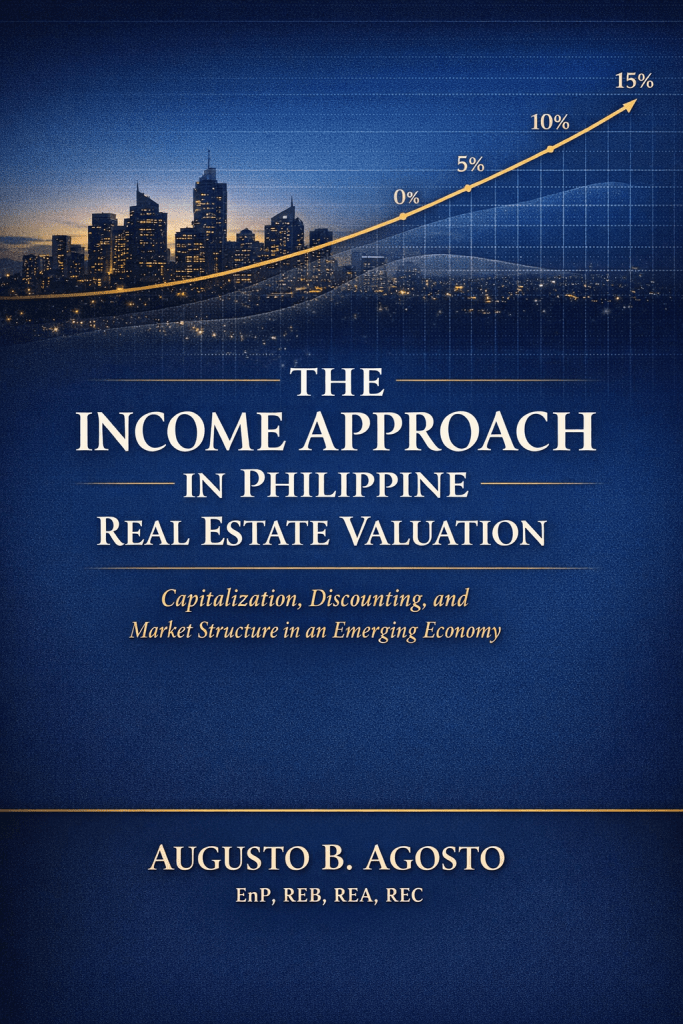
In every skyline, there is a story about capital.
Behind every office tower in Makati, every BPO building in Cebu IT Park, every industrial warehouse in Mandaue, and every resort hotel along our coastlines lies the same underlying question:
What is this property worth — and why?
For many, valuation is seen as a technical exercise. A computation. A compliance requirement for banks, regulators, or courts.
But income-producing real estate is not valued by arithmetic alone.
It is valued by expectation.
It is valued by risk assessment.
It is valued by how capital markets price future cash flow.
That is the intellectual foundation of the Income Approach — and that is why I wrote this book.
The Gap in Philippine Valuation Practice
In the Philippines, the Sales Comparison and Cost Approaches are widely applied. They remain essential. However, when we deal with commercial buildings, office towers, malls, industrial estates, mixed-use projects, and hotels, the economic reality is clear:
These assets are bought and sold for their income.
Yet income-based valuation is still unevenly practiced. Outside major appraisal firms and institutional transactions, Direct Capitalization and DCF modeling are often simplified, inconsistently applied, or misunderstood.
At the same time:
- The Supreme Court has recognized income-based methodologies in appropriate cases.
- REIT participation is reshaping yield expectations.
- Institutional capital is influencing cap rate compression.
- Infrastructure projects are shifting growth assumptions.
- Regional markets like Cebu are evolving rapidly.
The Philippine real estate market is maturing.
Our valuation discipline must mature with it.
What This Book Offers
This book is not a collection of formulas.
It is a structured explanation of the economic and financial logic behind the Income Approach — adapted to the Philippine market environment.
Inside, readers will find:
- A rigorous construction of Potential Gross Income
- Realistic modeling of vacancy and collection loss
- Disciplined treatment of operating expenses and replacement reserves
- The doctrine of Net Operating Income integrity
- A clear explanation of Direct Capitalization theory
- A practical, step-by-step guide to Discounted Cash Flow (DCF) modeling
- A deep exploration of the relationship between r (discount rate), R (cap rate), and g (growth)
- Philippine-specific methods of cap rate derivation and market extraction
- Case studies from Makati, Cebu, provincial CBDs, industrial corridors, and resort properties
- A structured approach to reconciliation and professional judgment
More importantly, the book demonstrates that Direct Cap and DCF are not competing tools — they are mathematically connected expressions of capital market logic.
Understanding that relationship transforms valuation from spreadsheet exercise into economic analysis.
Who Should Read This Book?
This book is written for:
- Professional appraisers and valuers who want deeper analytical discipline.
- Lawyers and judges dealing with expropriation, shareholder disputes, or partnership cases involving income-producing property.
- Real estate investors and developers who want to understand how markets price risk and growth.
- Students of real estate, finance, and urban economics who want to move beyond memorized formulas.
- Policy thinkers and planners who want to understand how capital flows shape urban value.
If you are involved in property where income matters, this framework matters.
Why This Conversation Is Important
Small changes in assumptions can move value by tens or hundreds of millions of pesos.
- A 0.5% shift in cap rate.
- A 1% change in growth.
- A slight adjustment in vacancy.
- An underestimated expense ratio.
The Income Approach magnifies assumptions.
That is why integrity, transparency, and disciplined modeling are essential.
A capitalization rate is not “chosen.”
It is defended.
A discount rate is not “assumed.”
It is justified.
Growth is not “optimistic.”
It is sustainable.
This book invites practitioners to approach income valuation with that level of seriousness.
An Invitation to Engage
Real estate is not static. It reflects economic structure, institutional confidence, liquidity, infrastructure, and long-term expectations.
When we value property through income, we are not simply dividing numbers.
We are interpreting capital market psychology.
If you are ready to deepen your understanding of how income becomes value — and how risk and growth shape pricing in the Philippine context — I invite you to read this book.
The Income Approach is not merely a method.
It is a way of thinking about property as capital in motion.
And that conversation is only beginning.

 Real Appraisal