
The Appraiser’s Notebook
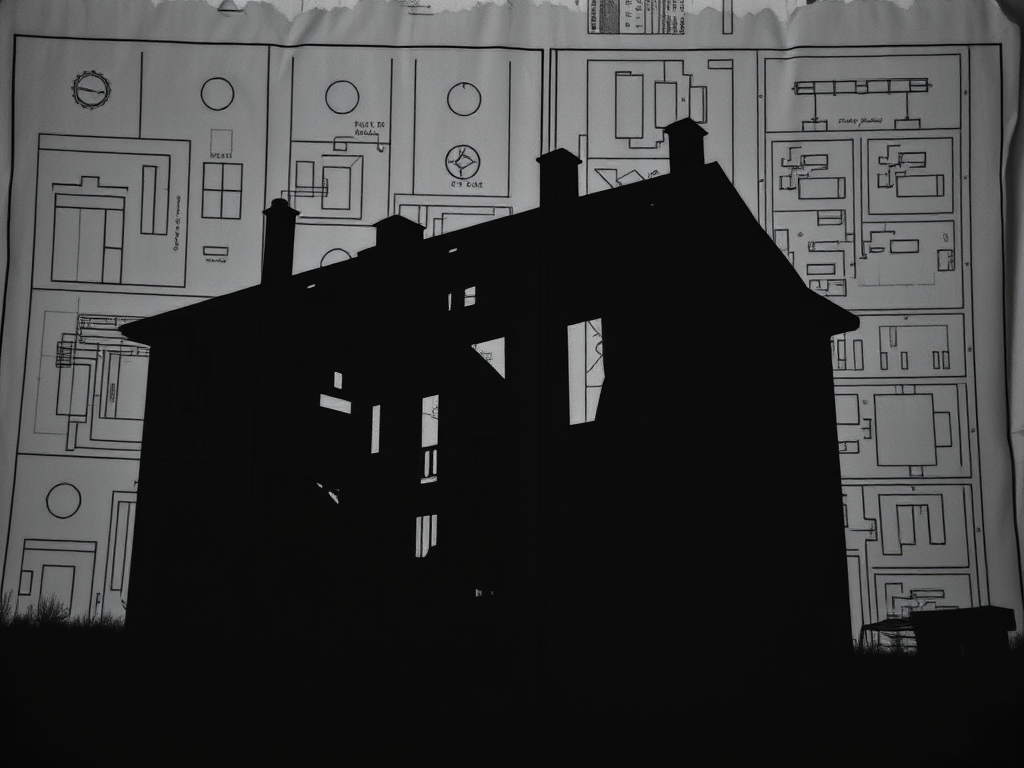
In the course of my work as an appraiser, I have visited countless buildings—some old, some new, some alive with human activity, and others long abandoned. But a few structures linger in my memory for reasons that go beyond architecture or appraisal value. I call them ghostly buildings—not because they house phantoms in the literal sense, but because they carry the weight of untold stories.
The Old Hospital
The old hospital experience remains etched in my memory. A 1960s-era hospital building, its mid-century concrete façade weathered by time. My assistant and our local guide were both visibly uneasy even before we entered. As an appraiser, on the other hand, I seemed curious—perhaps drawn by the same professional instinct that drives us to understand not just structures, but their histories. As we walked through the dark aisles, our guide whispered “tabi-tabi po” at every turn, tracing the sign of the cross as if asking unseen residents for permission to pass. The narrow hallways were lined with old gurneys and empty beds, each one a silent witness to suffering and loss. The air was thick, the silence broken only by the sound of our footsteps echoing off cracked tiles and hollow rooms.
The guide pointed to certain sections of the corridor and whispered, “Diyan po nila nilagay ang mga bangkay noon.” It was where the bodies of typhoon victims had once been laid. The building, left to decay, had become a relic of both tragedy and resilience—its power flickering intermittently, leaving us in long stretches of darkness as we made our way to the ICU and the birthing area. Each room seemed to hold a story: a sudden scream during a blackout, a nurse’s apparition caught in the corner of someone’s eye, the faint smell of alcohol and rust that never left.
Despite the unease, we completed the inspection—checking beams, walls, and flooring, as if the act of documenting and measuring could restore order to what had once been a place of chaos. Every corner carried a story, from the nurse seen near the supply room to the faint cries sometimes heard at night.
Yet amid the darkness, my duty remained the same: measure, observe, document. When we finally stepped out into the sunlight, my assistant let out a nervous laugh, as if trying to shake off whatever had followed us from inside. The guide looked visibly relieved, clutching his crucifix.
Still, that experience left me with a profound sense that buildings remember. They may be empty, but their walls absorb what once was—pain, hope, life, and death.
The “Taw-an” Floor
My second encounter came in a modern building that seemed the opposite of the first—sleek glass façade, spotless lobby, everything in order. Except for one thing: an unoccupied floor, which no one dared to visit.
It was known among the staff as the “taw-an” floor, a local term for a haunted place. Even at high noon, they said, you could hear a chain being dragged by something unseen. Doors would close on their own, lights flickered for no reason, and so the floor remained locked and empty.
Unaware of these stories, I conducted the inspection as usual. I noted the layout, checked the walls, the ventilation, the flooring. Nothing appeared unusual, though the stillness was almost unnatural—too quiet for a space meant for human activity.
Only after the inspection did one of the staff nervously tell me the story. “Sir, that’s the taw-an floor,” he said, his voice low. I could only smile. The staff seemed startled to see me unfazed—perhaps they expected anyone who entered that floor to return pale and shaken. I told them maybe I was simply too nerdy or too busy taking notes to sense such things. Or perhaps, I said with a laugh, I just don’t have the third eye.
Still, whenever I pass by that building, I recall the experience—the echo of silence, the dim corridor, and the weight of what I didn’t see.
Reflections
Both encounters taught me something subtle yet unforgettable: every building has its own story to tell. Some are written in blueprints, deeds, and cost sheets; others are etched in whispers and chills. For an appraiser, every inspection is a dialogue—not only with materials and dimensions but with memory itself.
And though my job is to assign value, sometimes the most haunting lesson is that not everything inside a structure can be measured.
“Every building has its stories to tell — some written in plans and deeds, others whispered through silence.”
 Real Appraisal